
Temperament Generator
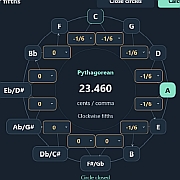
Temperament Generator — explore, design and understand twelve-note temperaments
Temperament Generator is a free, open-source desktop application for designing and analysing twelve-note temperaments. It lets you work directly with Pythagorean and syntonic comma fractions, calculate the resulting pitch deviations in cents, and experiment with automatic distribution of comma corrections. The program can also import and export tuning data as CSV, making it useful both for theoretical work and for preparing actual tuning charts.
A particularly useful feature is the interactive Harmony Lattice, which presents the temperament as a Tonnetz of fifths and major and minor thirds. Chords can be selected and examined individually, with the program showing exactly how far their intervals deviate from pure tuning. This makes it possible to see not only how a temperament is constructed, but also how its different keys and chords behave harmonically. Better yet, you can listen to the chords directly through a beautifully sampled Principal 8' pipe stop. The project is completely free and open source under the AGPLv3 licence.
Example: analysing a temperament from a tuning chart
Suppose you already have a temperament expressed as deviations from equal temperament, with A = 0 cents:
4.889; -6.517; 1.630; 9.777; -1.629; 6.518; -4.888; 3.259; -8.146; 0.000; 8.147; -3.258
These values correspond to C, C♯, D, D♯, E, F, F♯, G, G♯, A, A♯ and B. You would like to know how this temperament was constructed by its developer. You wish to know what comma splits were used and to what quints applied. Simply paste the values into the CSV input field and click CSV to fifths. Temperament Generator reconstructs the corresponding circle of fifths, showing how the comma is distributed between the fifths and calculating the resulting pitch of every note. The temperament can then be inspected visually and further modified directly in the circle.
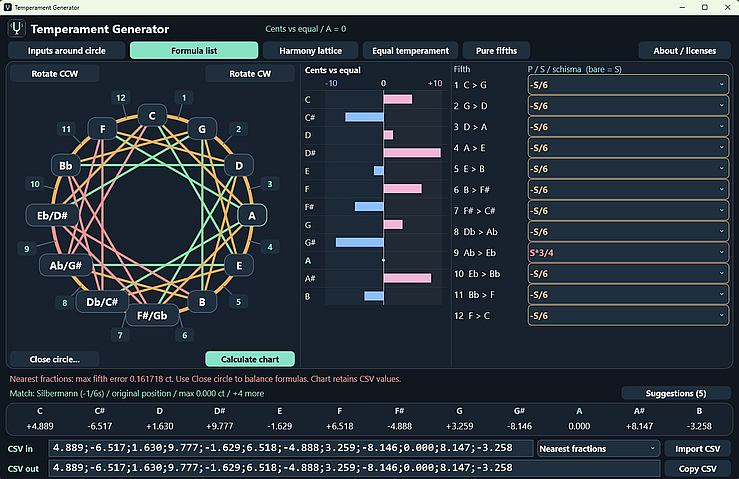
In this example, the program reveals a syntonic comma based temperament in which the fifths -1/6 fractions comma (except one wolf-quint). The resulting tuning chart makes the distribution of the deviations immediately visible, while the circle shows how the individual comma fractions combine to close the cycle. It shows how "good" the intervals and chords sound (green=good, yellow =tempered, red=harsh). Oh, yes, it is the reconstruction of G. Silbermann temperament, the program suggests it (it has an internal catalog of about 30 most notable temperaments).
Visit the web presentation of the tool: https://zurek-jiri.github.io/temperament-generator/
Download the latest version and explore the source code: Temperament Generator on GitHub
To download the ready-to-use application, open the GitHub repository and look for Releases in the panel on the right-hand side. The latest release contains the downloadable Windows version, while the repository itself contains the complete source code.